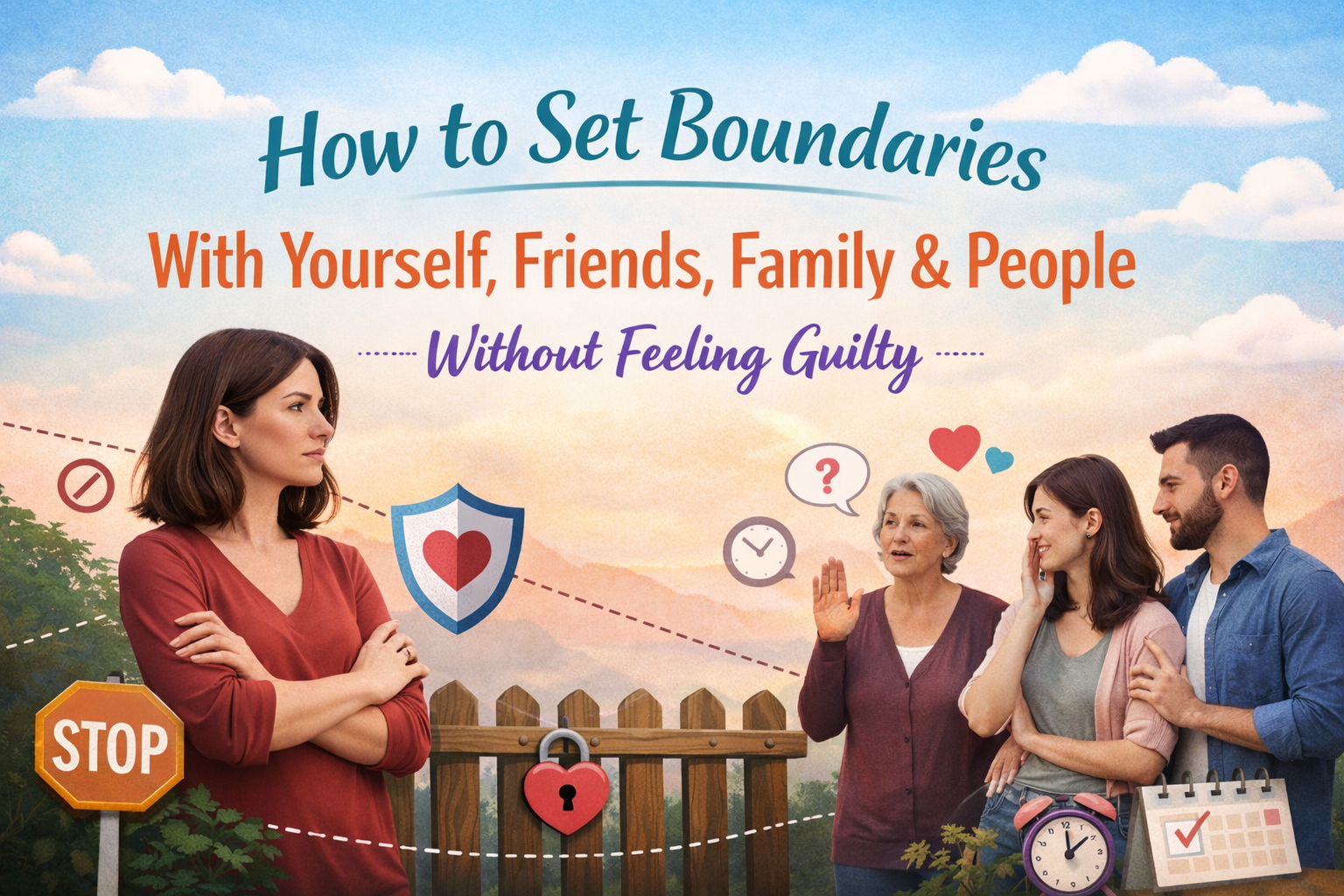
How to Set Boundaries With Yourself, Friends, Family, and People Without Feeling Guilty
How to Set Boundaries With Yourself, Friends, Family, and People Without Feeling Guilty
Let’s be honest — learning how to set boundaries is not something most of us were taught growing up. Especially juggling careers, relationships, friendships, maybe motherhood, and trying to hold ourselves together in between. Somewhere along the way, many of us learned that being “good” meant being available. That being loving meant sacrificing. That being supportive meant saying yes, even when we were exhausted.
And then we wonder why we feel overwhelmed. Why we’re resentful. Why we’re drained at the end of the day. If you’ve found yourself searching for how to set boundaries with yourself, how to set boundaries with friends, how to set boundaries with family, how to set boundaries with people, or even how to set healthy boundaries in relationships, you’re not alone. Most of us get to this point after we’ve hit emotional burnout and realize something has to change.
The truth is, setting healthy boundaries is one of the most powerful forms of self-respect. And no, it does not make you selfish.
What Are Healthy Boundaries and Why Do They Matter?
Healthy boundaries are the limits you create to protect your time, energy, emotions, and overall well-being. They are not walls designed to shut people out. Instead, they are guidelines that show others how you expect to be treated. 
When you don’t set boundaries, you slowly start abandoning yourself. You say yes when you want to say no. You tolerate comments that sting. You overextend yourself until you’re running on fumes. Over time, that leads to resentment, frustration, and emotional exhaustion.
On the other hand, when you learn how to set healthy boundaries, you begin to feel lighter. Your relationships improve because they’re based on mutual respect instead of silent resentment. You feel more confident because you’re honoring your needs. And most importantly, you stop feeling like your life belongs to everyone else.
How to Set Boundaries With Yourself
Before we talk about how to set boundaries with friends or family, we need to start with the most important relationship you have — the one with yourself.
Learning how to set boundaries with yourself means recognizing when you are the one pushing past your own limits. It means noticing when you’re exhausted but still saying yes. It means admitting that you don’t have endless energy, even if you wish you did.
For example, maybe you tell yourself you’ll just scroll for a few minutes before bed, and suddenly it’s midnight. Or you promise you won’t check work emails after dinner, but you do anyway. Setting boundaries with yourself requires discipline and self-awareness. It means deciding that your rest, your mental health, and your time matter.
It also involves protecting your schedule. If you don’t guard your time, it will always get filled. Creating time boundaries around work, social media, and availability can change your life more than you realize. And once you set those limits, you have to honor them. Otherwise, you teach yourself — and others — that your boundaries are optional.
How to Set Boundaries With Friends
Friendships should feel supportive and reciprocal. However, sometimes we find ourselves in friendships where we are constantly giving, listening, and accommodating, while our own needs take a back seat.
 If you’re trying to figure out how to set boundaries with friends, it likely means something feels unbalanced. Maybe you have a friend who expects you to answer every call immediately. Maybe they vent for hours but rarely ask how you’re doing. Or maybe they guilt you when you’re unavailable.
Setting boundaries with friends does not require confrontation or drama. Often, it simply requires clarity. You can express your needs calmly and directly. For example, you might say that you need more downtime during the week or that you can’t be available for late-night calls. You don’t need a long explanation. A clear statement is enough.
At first, it may feel uncomfortable. You might worry that you’re disappointing them. However, healthy friendships can withstand boundaries. In fact, they usually become stronger because they’re rooted in mutual respect. And if a friendship fades because you started honoring your needs, that tells you something important too.
How to Set Boundaries With Family
When it comes to how to set boundaries with family, things can feel more complicated. Family dynamics often run deep, shaped by years of patterns and expectations.
Perhaps a parent constantly critiques your life choices. Maybe a sibling frequently asks for financial help. Or maybe you feel obligated to attend every family gathering, even when you’re overwhelmed.
Setting boundaries with family begins with getting clear on what you will and will not tolerate. You might decide that certain topics are no longer open for discussion. You may choose not to lend money anymore. Or you might limit how often you attend events.
It’s important to understand that when you change your behavior, others may resist. They are used to the old version of you. That resistance does not mean your boundary is wrong. It simply means the dynamic is shifting. Staying calm and consistent is key. Over time, most people adjust. And if they don’t, you may need to create more distance to protect your peace.
How to Set Boundaries in Relationships
Romantic relationships require boundaries just as much as friendships and family relationships do. If you’ve been searching for how to set boundaries in relationships, you may be feeling unheard or emotionally stretched.
 Healthy relationships thrive on communication. Instead of waiting until resentment builds, it’s important to express your needs early. You might need alone time to recharge. You might require respectful communication during disagreements. Or you may need consistency and reliability.
Boundaries in relationships are not ultimatums. They are expressions of what you need to feel safe and respected. There is a difference between trying to control someone and protecting yourself. When you calmly communicate your limits and explain what you will do if those limits are crossed, you’re practicing self-respect.
Pay attention to how your partner responds. Someone who values you will listen and make an effort. Someone who dismisses your needs or calls you selfish is showing you where they stand.
How to Set Boundaries With People in Everyday Life
Beyond friends, family, and romantic partners, there are also coworkers, acquaintances, and others you interact with regularly. Learning how to set boundaries with people in general is a life skill that will serve you everywhere.
It often starts with identifying what behaviour feels uncomfortable or overwhelming. From there, you communicate your limit clearly and concisely. You don’t need to over-explain or defend yourself. And once you’ve stated your boundary, you follow through consistently.
For instance, if meetings regularly run past your work hours and leave you drained, you can communicate that you will need to leave at a specific time moving forward. By enforcing that consistently, you teach others to respect your schedule.
The more you practice, the more natural it becomes.
Why Setting Boundaries Feels So Guilty
One of the biggest reasons women struggle with how to set healthy boundaries is guilt. You might feel selfish. You might worry about hurting someone’s feelings. You might fear being seen as difficult.
Often, this guilt stems from conditioning. Many of us were praised for being accommodating and selfless. So when we begin prioritizing ourselves, it feels wrong at first.
However, guilt does not automatically mean you’re doing something bad. Sometimes it simply means you’re doing something new. Growth can feel uncomfortable, especially when it challenges old patterns.
How to Set Healthy Boundaries Without Feeling Guilty
While you may not eliminate guilt entirely, you can shift your perspective. Instead of seeing boundaries as rejection, try viewing them as self-respect. You are not pushing people away; you are creating a healthier dynamic.
It can also help to start small. Practice saying no in low-pressure situations. Allow yourself to decline invitations or delay responses without a detailed explanation. As you build confidence, the guilt tends to lessen.
Most importantly, remind yourself that you are not responsible for managing everyone else’s emotions. You are responsible for being honest and respectful. How others respond to your boundary is ultimately up to them.
What Changes When You Start Setting Boundaries
In the beginning, it may feel awkward. People may question you. You may second-guess yourself. But as you continue, something shifts internally.
You begin to feel lighter. You sleep better. You notice that your relationships feel more authentic. You respect yourself more deeply because you are no longer abandoning your needs.
Learning how to set boundaries with yourself, friends, family, and people without feeling guilty is not about becoming cold or distant. It’s about becoming emotionally healthy. It’s about creating relationships that are rooted in respect instead of obligation.
You are allowed to protect your time. You are allowed to protect your peace. You are allowed to say no without writing a full essay explaining why.
Setting healthy boundaries does not make you selfish. It makes you strong, self-aware, and emotionally mature.
And the more you practice, the easier it becomes.